Categories: Nevada, Outdoors
By Westward Vibes

Photo via Wikimedia Commons, public domain.
Ghost Towns of the Silver State: 6 Nevada Ghost Towns Worth the Drive (and What’s Still Standing)
Buckle up, history nerds — Nevada is one giant outdoor museum of boom-and-bust. Hundreds of mining camps flared across the Silver State; a handful froze in time with enough standing buildings, wild stories, and photo ops to earn the drive. Here are six ghost towns with our honest worth-the-drive verdicts.
1. Rhyolite — The Movie-Star Ruin
If you only visit one Nevada ghost town, make it Rhyolite. Gold was discovered here in 1904, and within a few years several thousand people were living in what was briefly one of the most advanced towns in the region — electric lights, piped water, telephones, a stock exchange, an opera house, and some 50 saloons. Then the 1907 financial panic hit, the ore played out, and by the early 1910s the town was emptying as fast as it had filled.
What’s still standing is pure cinema. The skeletal three-story Cook Bank Building — which cost $90,000 to build in 1907 — is one of the most photographed ruins in the West. Tom Kelly’s Bottle House, built in 1906 from some 50,000 beer and liquor bottles set in adobe, is a marvel of frontier recycling (Paramount Pictures restored it in 1925 as a set for the silent film The Air Mail). The old train depot, which once served three railroads, still stands fenced but photogenic.
- Location: About 4 miles west of Beatty off State Highway 374, roughly 120 miles northwest of Las Vegas
- Hours: The BLM-maintained townsite is open around the clock — no gates, no tickets.
- Admission: Free
- Verdict: The easiest, most photogenic ghost town in Nevada — pair it with the Goldwell Open Air Museum and a Death Valley run.
Pro Tip: There are zero services in Rhyolite — no gas, no food, no water. Top off the tank and grab snacks (or BBQ) in Beatty first.
2. Goldfield — The Living Ghost Town
Goldfield isn’t quite a ghost town and isn’t quite alive, which is exactly its charm. After gold was discovered in 1902, this became the largest and wealthiest city in Nevada, home to tens of thousands at its peak. Most of the mines were in decline by 1910, a flood hit in 1913, and a devastating fire in 1923 leveled much of the town. Today a few hundred residents remain.

Photo by Terrisa Meeks, via Wikimedia Commons, CC BY 2.0.
The star of the show is the Goldfield Hotel (1908) — once billed as the most luxurious hotel between Chicago and San Francisco, and today one of the most haunted buildings in Nevada, a regular on ghost-hunting TV shows. It opens for rare tours during Goldfield Days each August. Don’t miss the International Car Forest of the Last Church, where painted cars and buses stick straight out of the desert dirt like headstones, and the Santa Fe Saloon, pouring since 1905.
- Location: On U.S. 95, about 30 minutes south of Tonopah (roughly 3 hours northwest of Las Vegas)
- Hours: The town itself never closes; individual attractions and tours keep their own hours.
- Admission: Free to wander; tours and festival events are priced separately.
- Worth-the-drive verdict: Yes — especially if you love haunted history and weird art. It’s the rare ghost town where you can grab a drink in a 120-year-old saloon afterward.
Pro Tip: Time your visit for Goldfield Days (first weekend in August) if you want inside the Goldfield Hotel — that’s when the rare guided tours happen.
3. Belmont — The Courthouse That Wouldn’t Die
For a few wild years in the late 1800s, Belmont was Nevada’s second-largest community, a silver camp of about 2,000 people. It held the Nye County seat from 1867 until 1905, and its crown jewel — the two-story brick Belmont Courthouse, completed in 1876 with bricks made on site — still stands largely intact. When the mines died, most buildings were stripped of their valuable timber roofs; the courthouse kept its roof, and today it’s a Nevada state historic site.
The courthouse carries a deliciously creepy footnote: legend holds that Charles Manson carved his name inside during a visit with his followers (never officially confirmed — but guides love the story). Elsewhere in town you’ll find Dirty Dick’s Belmont Saloon, a seasonal solar-powered watering hole, and the towering brick chimney of the Monitor-Belmont Mill — reportedly used for target practice by Air Force pilots during World War II.
- Location: About 45 miles northeast of Tonopah
- Hours: The townsite exterior is always accessible; interior courthouse tours run on select weekends in warmer months — confirm ahead.
- Admission: Free to explore the townsite
- Worth-the-drive verdict: Worth it for ghost-town purists. It’s remote, quiet, and feels genuinely frozen — but the dirt roads demand respect.
Pro Tip: Bring a high-clearance vehicle and everything you need — Belmont is deep in the middle of nowhere, which is precisely the point.
4. Berlin-Ichthyosaur State Park — Ghost Town Meets Sea Monsters
Only in Nevada do you get a two-for-one: a preserved mining ghost town and 225-million-year-old sea monsters in the same state park. Berlin was founded in 1897, peaked at around 250 residents, and was abandoned by 1911 when the mine played out. Because the town was never scavenged the way most camps were, its buildings — including a 30-stamp mill and the machine shop — survive in a state of ‘arrested decay,’ with interpretive signs along a self-guided walking trail.
Then there’s the other half of the park: the largest known concentration of ichthyosaur fossils in North America. These giant marine reptiles — Nevada’s official state fossil — swam over central Nevada when it was covered by a warm ocean. The park’s Fossil House protects the exposed skeletons right where they were found, with guided tours in the non-winter months. A 130-year-old mill plus a 50-foot sea reptile: a combination you will not find anywhere else on Earth.
- Location: Off State Route 844, about 16 miles east of Gabbs in northern Nye County
- Hours: Open year-round; at 7,000 feet, winter access can be tricky — check Nevada State Parks before you go.
- Admission: Nevada State Parks day-use fee applies — check the official website for current rates.
- Worth-the-drive verdict: One of the most unique stops in the state. The drive in is an adventure, but dinosaur-adjacent ghost towns don’t grow on trees.
Pro Tip: Fuel up and grab food before you leave the highway — and if you pass through Middlegate, the famous monster burger at Middlegate Station is a rite of passage.

Photo by Famartin, via Wikimedia Commons, CC BY-SA 4.0.
5. Pioche — The Town That Murder Built
Pioche was one of the roughest mining camps in the Old West, and it wears the reputation like a badge. Legend holds that dozens of men died in gunfights and disputes before a single resident managed to die of natural causes — and the town’s landmarks tell the tale.
The headliner is the Million Dollar Courthouse (1872). What was supposed to be a $26,000 building ballooned through cost overruns and interest into a debt approaching a million dollars — which Lincoln County didn’t finish paying off until 1938. Today the restored building houses a local history museum. Pair it with Boot Hill, the hillside cemetery of weathered wooden headstones, and look up: an old aerial ore tram still dangles its cars over the canyon.
- Location: On U.S. 93 (the Great Basin Highway), about 180 miles north of Las Vegas
- Hours: The town is always open; museum hours vary — confirm ahead.
- Admission: Free to wander; museum admission varies.
- Worth-the-drive verdict: A fantastic overnight stop on an eastern Nevada road trip — and it’s only 10 miles from the hoodoos of Cathedral Gorge State Park.
Pro Tip: Stay for sunset at Boot Hill — the light on the old wooden markers is unreal, and you’ll likely have the whole hill to yourself.
6. Goodsprings — The Saloon That Outlived the Mine
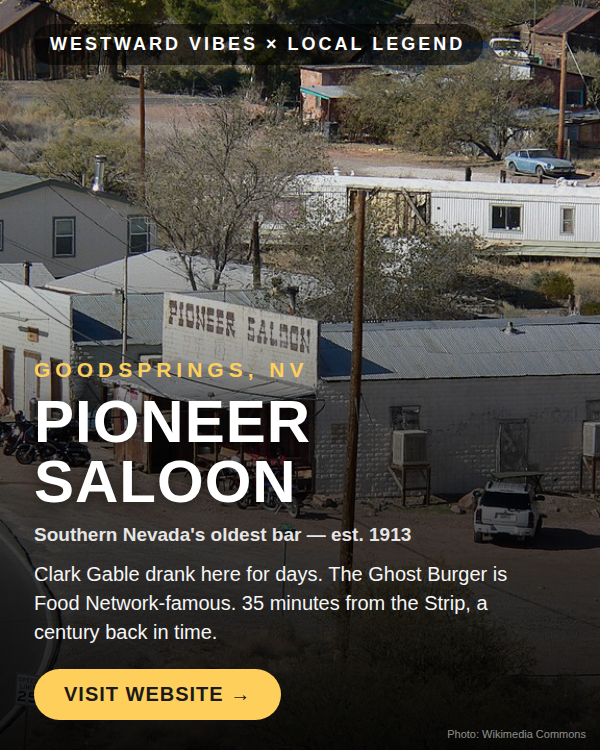
Thirty miles southwest of Las Vegas, Goodsprings is the ghost town you can visit between brunch and dinner. Mormon miners found lead here in 1856, and the town boomed again with zinc during World War I before fading. What keeps it alive is the Pioneer Saloon, built in 1913 and the oldest bar in southern Nevada — with a stamped-tin ceiling ordered from Sears and Roebuck and a Brunswick bar counter salvaged from Rhyolite after its bust.
The saloon’s walls have stories: in 1942, Clark Gable waited here for days for news after his wife Carole Lombard’s plane crashed into nearby Mt. Potosi — you can still see his cigarette burns on the bar. Order the famous Ghost Burger and say hi to the 1913 schoolhouse, listed on the National Register of Historic Places.
- Location: 310 W Spring St, Goodsprings, NV 89019 — about 30 miles southwest of Las Vegas
- Hours: The saloon and café keep their own hours — check before you roll out.
- Admission: Free to visit the town
- Worth-the-drive verdict: The easiest ghost town on this list and a perfect half-day escape from the Strip. Go hungry.
Pro Tip: The Ghost Burger lives up to the hype, and the saloon’s museum room is packed with film and TV memorabilia — ask the bartender for the stories.

Photo by Sergiy Galyonkin, via Wikimedia Commons, CC BY-SA 2.0.
Six towns, six flavors of boom-and-bust — from Rhyolite’s movie-star ruins to a saloon that outlived its mine by a century. Fill the tank, pick one, and go walk where the silver barons walked.