
The Mother Road Turns 100 — and Arizona Kept the Best of It
On November 11, 1926, the United States gave a number to a patchwork of dirt, gravel, and fresh pavement running from Chicago to Los Angeles, and U.S. Route 66 was born. A century later, the road itself turns 100 — and if you want to drive it the way it actually felt, you go to Arizona.
That’s not booster talk. When the interstates carved up the Mother Road, Arizona held on to the longest unbroken stretch of the original highway left in America: well over a hundred miles of two-lane running west from Seligman through Kingman to Topock on the Colorado River, plus a string of mountain and high-desert towns to the east — Williams, Flagstaff, Winslow, Holbrook — where the road still runs down main street. Better still for us: it all starts about two hours from Las Vegas. Here’s how to drive it in the centennial year, sleeping in the motels that made it famous.
The Town That Saved the Road: Seligman
Every Route 66 pilgrimage in Arizona should start in Seligman, because without Seligman there might be nothing left to pilgrimage to.
On September 22, 1978, Interstate 40 opened around the town, and the traffic — thousands of vehicles a day past Angel Delgadillo’s barber shop — simply vanished. Seligman did what bypassed towns were supposed to do: it started dying. Angel, the town barber, refused to go along. On February 18, 1987, he gathered fifteen business owners from Route 66 towns across Arizona at the Copper Cart restaurant and founded the Historic Route 66 Association of Arizona. That November, the state designated the Seligman-to-Kingman road an Arizona Historic Road — the first “Historic Route 66” anywhere — and the preservation movement that spread to all eight Route 66 states started right here. Arizona has since declared Seligman, by legislative decree, the “Birthplace of Historic Route 66.”

Today Seligman is a joyful half-mile of murals, gift shops, and gleaming chrome. Get a burger at Delgadillo’s Snow Cap Drive-In, built by Angel’s brother Juan in 1953 out of scrap lumber and a century’s worth of practical jokes (the door has two knobs; one is a decoy). Stop into Angel’s barber shop, now part visitor center, part shrine. Then point the car west — the road out of town is the main event.

The Longest Stretch: Seligman to Kingman (and Beyond)
From Seligman, old Route 66 — signed as AZ-66 — unspools west through some of the emptiest, prettiest high-desert country in the state. This is the longest continuous surviving alignment of the original highway, and it drives like 1955: two lanes, long straights, telephone poles marching to the horizon, and tiny communities that exist because the road does.

Roll through Peach Springs, capital of the Hualapai Nation, and past the turnoff for Grand Canyon Caverns, a roadside attraction since the 1920s. Stop at the Hackberry General Store, a gloriously cluttered museum-shop of gas pumps, signs, and a very red Corvette. Valentine and Truxton blink by. Then the road climbs into Kingman, the stretch’s western anchor: the Powerhouse Visitor Center houses the Arizona Route 66 Museum, and Beale Street does a fine line in diners and neon (Mr. D’z is the photo you’re thinking of). Got more time? The old road keeps going west through the Black Mountains to burro-patrolled Oatman and down to Topock — a full extra day, and worth it.


East of Seligman: Williams, Flagstaff, Winslow, Holbrook
Head east instead and the road climbs into the pines. Williams was the last town on Route 66 bypassed by I-40 — it held out until October 13, 1984, after local business owners legally fought the freeway, which is exactly why Bill Williams Avenue survives as one unbroken, neon-lit historic district instead of fragments. It’s also the “Gateway to the Grand Canyon”: the Grand Canyon Railway has run from the 1908 Williams depot to the South Rim since 1989, so a canyon day fits right into a Route 66 trip.

Flagstaff, at nearly 7,000 feet, gives you ponderosa air, a walkable downtown threaded by the old road, and Lowell Observatory on the hill above it. Winslow is next, and yes, you are legally required to stand on the corner — the park at 2nd and Kinsley, complete with statue, mural, and a flat-bed Ford, honors the Eagles’ “Take It Easy.” But Winslow’s real treasure sits a block away: La Posada, the 1930 Fred Harvey hotel designed by Mary Colter, widely considered her masterpiece. Saved from demolition and restored room by room, it’s again a working hotel and art museum, and its Turquoise Room is serving some of the best Southwestern cooking in Arizona — make a dinner reservation and thank us later.


End the line in Holbrook, where the road’s grand finale is a place to sleep.
Sleep in a Wigwam: The Motels That Made the Road
Route 66 invented the American roadside motel, and Arizona’s stretch lets you sleep in the originals — booked direct, still family-run, and very much not museums.
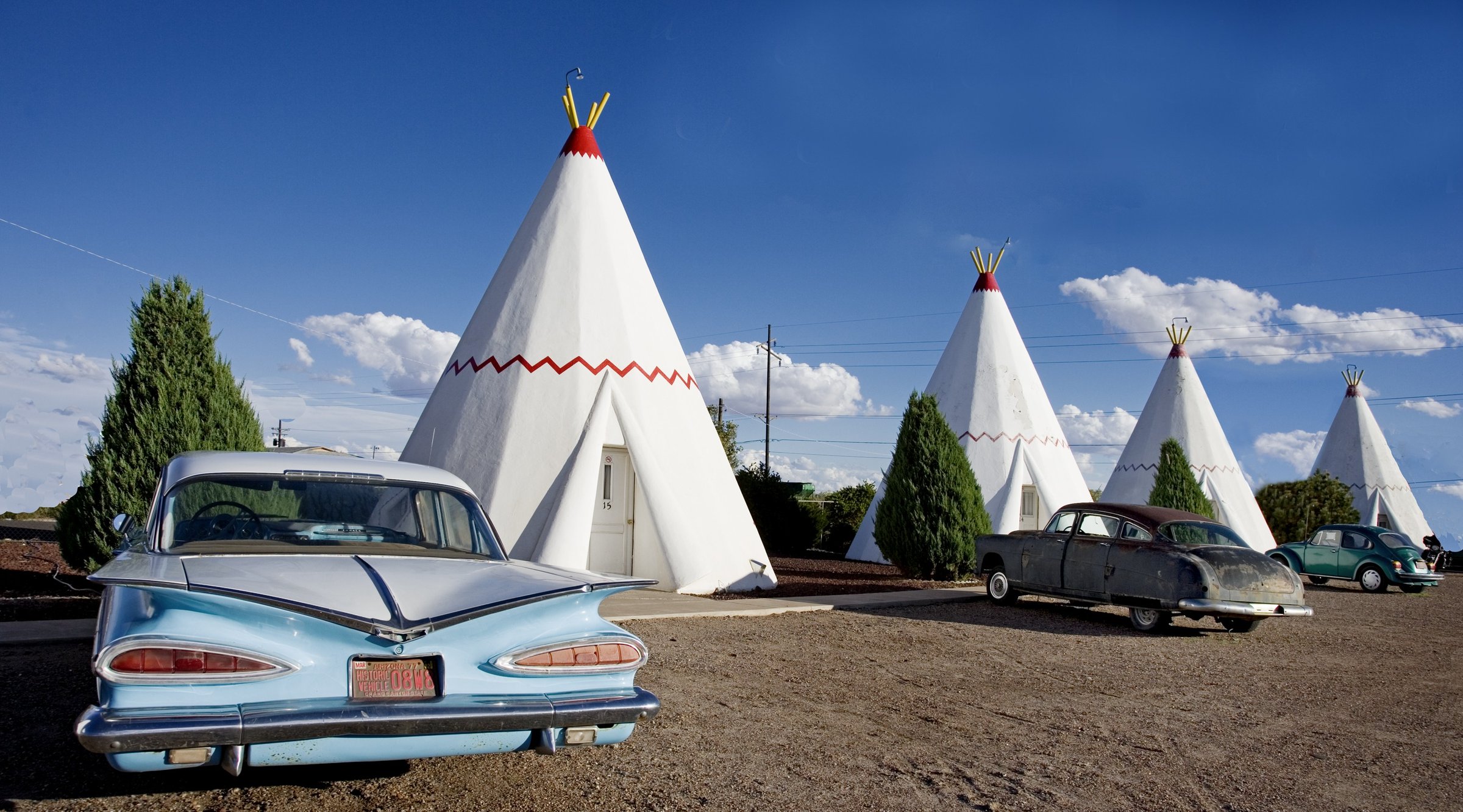
Wigwam Motel, Holbrook. Chester E. Lewis built his village of fifteen concrete teepees in 1950, and the Lewis family — who bought the motel back in 1988 after it had dwindled into a gas station — runs it still. Each wigwam is a real room (private bath, A/C, vintage hickory furniture), a classic car is parked outside, and the office doubles as a museum of Chester’s collections. It’s on the National Register of Historic Places and inspired the Cozy Cone in Pixar’s Cars — and with only fifteen wigwams, it books out. Reserve early, and note the front desk keeps roadside hours (check-in from 3 p.m.). We feature it in our boutique hotels directory for a reason: this is the single most Route 66 night’s sleep in America. Petrified Forest National Park, which the old road once ran straight through, is about twenty miles east — go at golden hour.

La Posada, Winslow. If the Wigwam is the road’s playful side, La Posada is its grand one: the last of the great Harvey Houses, opened in 1930, closed in 1957, and miraculously saved. Rooms are individually decorated, the gardens are made for evening wandering, and trains still roll past the back lawn — Winslow is an Amtrak stop, so you can even arrive the old way.
Between Kingman, Seligman, Williams, and Flagstaff you’ll find plenty more vintage motor courts wearing their neon proudly; our rule for the centennial year is simple — if it has a real sign, a real owner, and a parking spot six steps from your door, it beats the interstate interchange every time.
The Centennial Year: What’s Still on the Calendar
Arizona celebrated all year — Seligman’s Centennial Celebration on April 30, the 800-car Historic Route 66 Fun Run from Seligman to Topock on May 1–3, the Hotel Beale neon sign in Kingman relit in May for the first time in over forty years, and Winslow’s Standin’ on the Corner Festival in late September. But the date that matters most is still ahead: the road’s actual 100th birthday, Wednesday, November 11, 2026. If you can only make one centennial drive, make it that week — cool weather, low sun on the two-lane, every town in a birthday mood. Runners get the last word: the Route 66 UltraRun covers the Seligman-to-Topock stretch on foot, November 13–16.
The 3-Day Drive Plan from Las Vegas
Day 1 — Las Vegas → Kingman → Seligman (about 180 miles). US-93 south to Kingman (roughly 105 miles, under two hours). Coffee, the Route 66 Museum at the Powerhouse, then take AZ-66 — the longest stretch — east through Hackberry and Peach Springs to Seligman by late afternoon. Snow Cap for dinner-adjacent snacks; sleep in Seligman or push on to Williams.
Day 2 — Seligman → Williams → Flagstaff (about 110 miles). Morning in Williams: walk Bill Williams Avenue, and if the Grand Canyon is calling, this is your railhead. Continue to Flagstaff for lunch downtown and a ponderosa-cool evening. Sleep in Flagstaff — or drive the extra hour and check into La Posada in Winslow for the full Harvey House treatment.
Day 3 — Flagstaff → Winslow → Holbrook (about 90 miles). Stand on the corner in Winslow, tour La Posada (stay for a Turquoise Room lunch), then finish in Holbrook: Petrified Forest National Park in the late light, and a concrete teepee at the Wigwam Motel for the night. The drive back to Las Vegas runs about five and a half hours via I-40 and US-93 — or linger, because by day three the interstate feels loud, fast, and entirely beside the point.
The Mother Road’s second hundred years is being written by the people who refused to let it go — barbers, motel families, and small towns that bet on a two-lane road. The least we can do is drive it slowly, stop often, and sleep in a wigwam.